

Blog
Updated: March 2026 lab diamond vs natural diamond ring
If you’re shopping for a diamond ring in 2026, you’ve already encountered the question: lab diamond or natural diamond? A few years ago, this felt like a niche debate. Today, it’s the most important decision you’ll make when buying a ring — and the data has never been clearer.
This guide cuts through the marketing noise and gives you an honest, data-backed comparison so you can make the right call for your budget, values, and long-term expectations.
What Is a Lab Diamond?
A lab diamond — also called a lab-grown or synthetic diamond — is a real diamond grown in a controlled laboratory environment. Scientists replicate the extreme heat and pressure found deep within the Earth using one of two methods:
- HPHT (High Pressure High Temperature): Mimics the natural geological process. A small diamond “seed” is placed under intense pressure (around 1.5 million PSI) and high heat (around 2,700°F) until carbon atoms crystallize around it.
- CVD (Chemical Vapor Deposition): A carbon-rich gas is ionized into plasma, depositing pure carbon atom-by-atom onto a diamond seed, growing the crystal layer by layer.
The result is a diamond that is chemically, physically, and optically identical to a natural diamond. The only difference is where it was born.
What Is a Natural Diamond?
A natural diamond forms over 1 to 3.3 billion years, roughly 100 miles below the Earth’s surface, under immense geological pressure and heat. Volcanic eruptions carry them to the surface through formations called kimberlite pipes, where they are mined.
Natural diamonds carry geological rarity, a sense of history, and a deep cultural tradition — especially in engagement rings. However, they also come with a significantly higher price tag and complex ethical supply chains.
Are Lab Diamonds “Real” Diamonds?
Yes — 100%. This is the most common misconception in the jewelry world.
The Gemological Institute of America (GIA), the gold standard in diamond grading, certifies both natural and lab-grown diamonds using the same 4Cs framework. Lab diamonds score identically on every measurable property: chemical composition (pure carbon), crystal structure, hardness (10/10 on the Mohs scale), refractive index, and brilliance. Even a trained gemologist cannot tell them apart with the naked eye.
Lab diamonds are not cubic zirconia. They are not moissanite. They are real diamonds. The question isn’t “real vs. fake” — it’s about origin, price, and what matters most to you.
Price Comparison 2026: The Numbers Are Staggering
This is where the conversation has shifted most dramatically.
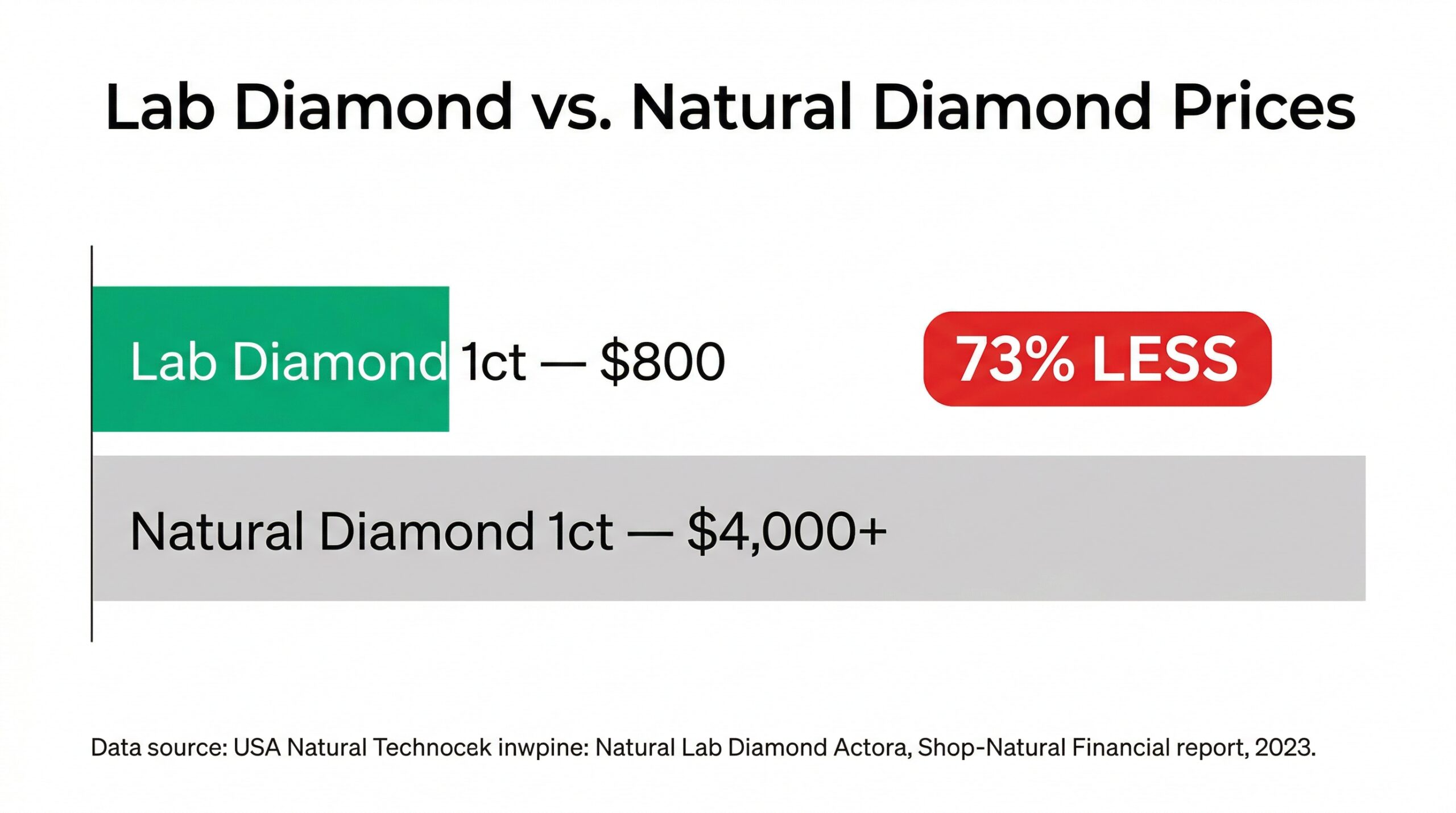
According to proprietary data from insurance technology company BriteCo (published March 9, 2026), lab-grown diamonds now cost 73% less than natural diamonds on average. aol.com
Here’s what that means in real terms:
- A 1-carat G/VS1 lab diamond is available for under USD 800 in 2026.
- An equivalent 1-carat natural diamond typically costs USD 4,000 or more.
- Lab diamond prices have fallen 90% since 2016, when a 1-carat stone cost USD 4,000.
thecaratcut.com
- Lab prices are still declining — down 9.2% year-over-year into Q1 2026.
dracodiamond.com
What does this mean for buyers? Your entire budget stretches dramatically further with a lab diamond. Instead of a 0.75-carat natural stone, you could get a 2.5–3 carat lab diamond at the same price — with identical brilliance.
The 4Cs: Cut, Color, Clarity, Carat
Both lab and natural diamonds are graded using the exact same 4Cs framework by gemological labs like GIA, IGI, and AGS:
- Cut: Determines brilliance and sparkle. Both types can achieve Excellent/Ideal cut grades.
- Color: Graded D (colorless) to Z (light yellow). Lab diamonds frequently achieve D–F colorless grades at far lower cost.
- Clarity: Ranges from Flawless to Included. Lab diamonds often show fewer inclusions due to controlled growth conditions.
- Carat: Weight is identical between both types at the same size.
Bottom line: The 4Cs don’t favor either type — what matters is buying a well-cut, certified stone regardless of origin.
Resale Value and Investment Reality
This is where natural diamonds hold a genuine edge — but it’s more nuanced than the marketing suggests.
- Natural diamonds retain approximately 20–60% of their original retail value on resale, depending on size, quality, and market timing.
- Lab diamonds currently resell at roughly 10–40% of their purchase price, with the lower end becoming more common as lab diamond prices continue falling.
tashvi.ai
If you’re thinking about a diamond ring as a store of value or a multi-generational heirloom, natural diamonds have an argument. However, if you’re planning to keep the ring (as most people do), the resale value question is largely academic. You’re not buying a ring to sell it.
The smarter financial lens: with a lab diamond, you spend USD 1,500 instead of USD 6,000, put the difference elsewhere, and wear a ring that looks identical to the USD 6,000 version.
Ethical & Environmental Considerations
Lab diamonds: Generally require less land disruption and carry no conflict-diamond concerns. However, they do consume significant electrical energy during production — the environmental footprint depends on whether the manufacturing facility uses renewable energy.
Natural diamonds: The industry has made significant strides with the Kimberley Process to certify conflict-free stones, but the system is not perfect. Large-scale mining still carries environmental and humanitarian risks depending on the source country. Look for diamonds certified by reputable bodies (GIA, AGS) with traceable origins.
If ethics and sustainability are priorities for you, a lab diamond from a manufacturer transparent about its energy sourcing is typically the stronger choice. silvadi.com
Who Should Choose a Lab Diamond Ring?
- ✅ Budget-conscious buyers who want maximum size and quality for their money.
- ✅ Couples who prioritize size and brilliance over geological origin.
- ✅ Eco-conscious and ethically-minded buyers.
- ✅ Millennials and Gen Z who view tradition as optional, not obligatory.
- ✅ Anyone who wants to customize a ring with a larger centerstone.
Who Should Choose a Natural Diamond Ring?
- ✅ Buyers who value geological rarity and the romance of Earth’s history.
- ✅ Those buying as a long-term investment or family heirloom.
- ✅ Couples for whom tradition and cultural symbolism are important.
- ✅ Buyers in markets where natural diamonds hold stronger perceived prestige.
2026 Market Trends: Lab Diamonds Are Now the Majority
The market has spoken. According to BriteCo data (March 2026):
- Lab-grown diamonds now account for more than 45% of all US engagement ring purchases.
aol.com
- Separate analysis from Tashvi AI estimates that over 55% of engagement rings in 2026 feature lab-grown diamonds.
- The trend is driven primarily by Millennials and Gen Z who are less tradition-driven and more data-driven in their purchasing decisions.
This shift is not a passing fad. It reflects a fundamental change in how consumers define value, luxury, and love. lab diamond vs natural diamond ring
Final Verdict: Which Should You Choose?
There is no universally “right” answer — but here’s a simple decision framework:
Choose a lab diamond if you want the most beautiful ring for your budget, you care about ethics and sustainability, and you’re not planning to resell it.
Choose a natural diamond if geological rarity and tradition are deeply meaningful to you, you’re buying as a long-term investment or heirloom, or your partner has a strong preference for a mined stone.
Either way, the most important thing is to buy a certified, well-cut stone from a reputable jeweler — and to customize it into a ring that reflects your unique story.
Ready to Design Your Perfect Diamond Ring?
Whether you choose lab or natural, the real magic is in the custom design. A skilled custom jewelry manufacturer can bring your vision to life — the exact setting, metal, style, and stone that tells your story, not a cookie-cutter version from a mall display case.
Work with a custom jewelry manufacturer who sources both lab and natural certified diamonds, so you can make the choice that’s right for you — without pressure.lab diamond vs natural diamond ring


