


Blog
How Brands Source an 18K Gold Jewelry Manufacturer
Manufacturer Rings is a key topic for jewelry brands evaluating OEM manufacturing and custom production options.
Brand owners now treat 18K gold as the backbone of a profitable fine jewelry line. Gold trades near record highs, so every gram of alloy matters more than ever to margin planning.
Meanwhile, private-label programs teams lowered actively the barrier to launching a collection. This guide explains how 18K gold OEM wholesale actually works, from karat economics to hallmarking and delivery.
Why 18K Gold OEM Sourcing Is Trending
Three shifts are pushing brands toward factory-direct 18K gold programs.
- Gold at record highs. Buyers watch metal cost closely, so brands need precise gram weights and honest alloy control.
- Private label is mainstream. Retailers and influencers launch jewelry lines without owning a workshop.
- Category expansion. Necklaces, bracelets, earrings, cufflinks, and fashion rings now share one supply chain.
Consequently, sourcing decisions moved from “who is cheapest” to “who controls quality and color consistently.”
What Defines 18K Gold Jewelry Manufacturing
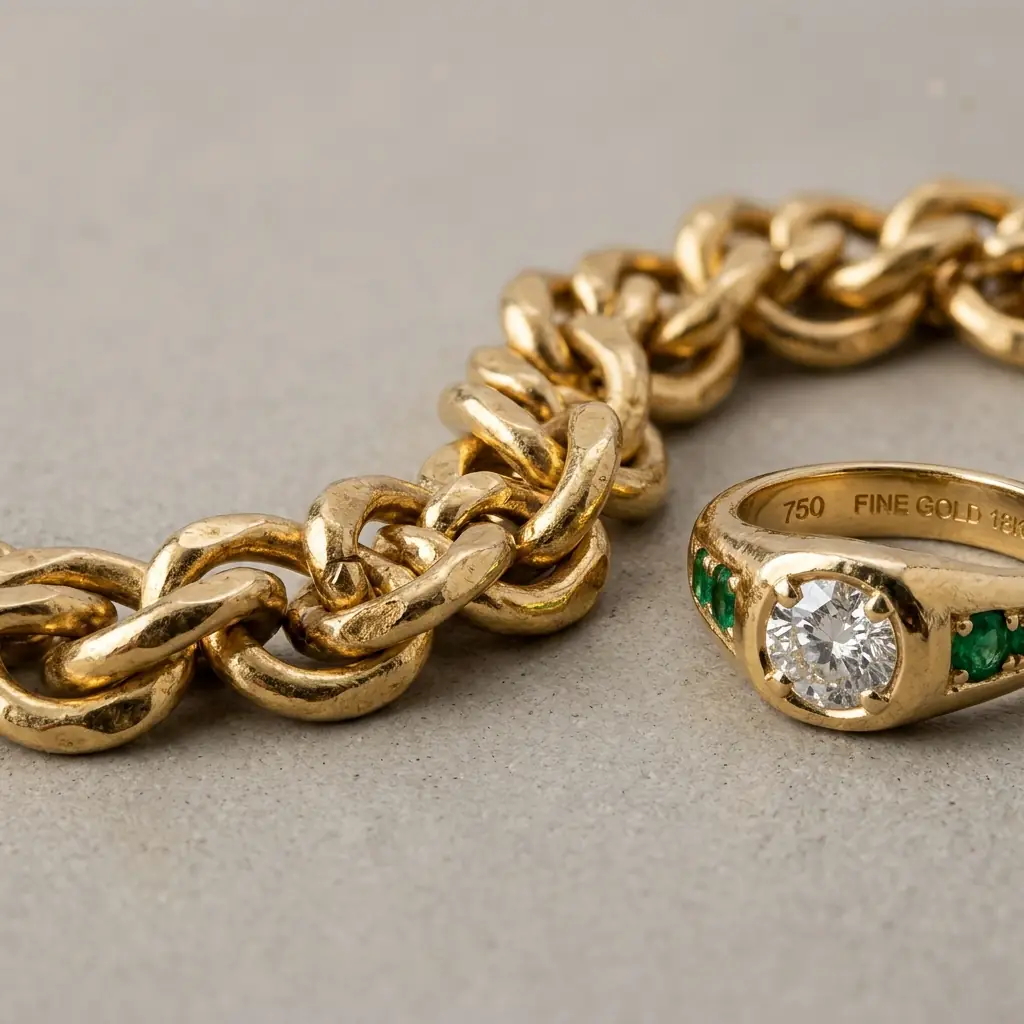
18K gold is an alloy of 75% pure gold and 25% other metals. That ratio gives it a hard, durable surface and a rich color that holds up in daily wear.
- Karat: 18K (750 hallmark) sits between 14K durability and 22K softness.
- Color control: The 25% alloy blend determines yellow, white, or rose tones.
- Hallmarking: Pieces carry a 750 stamp plus maker and assay marks where required.
- Finish options: High polish, satin, brushed, and rhodium plating for white gold.
- Category range: One factory can produce necklaces, bracelets, earrings, cufflinks, and fashion rings on the same CAD platform.
Key Factors for 18K Gold OEM and Wholesale Programs
Karat Economics and Luxury Positioning
18K gold carries 75% fine gold, so material cost dominates the bill of materials. However, the higher karat also supports premium retail positioning. Customers read 18K as a luxury signal, and that perception protects margin better than thin 9K or 10K constructions. For this reason, many brands run 18K as their hero line and use 14K for entry price points.
Color Control and Alloy Consistency
Color drift is the most common quality complaint in gold programs. A reliable manufacturer fixes alloy recipes and documents them per SKU. In addition, white gold needs consistent rhodium plating thickness, while rose gold depends on a stable copper ratio. Therefore, always request color samples from the same alloy batch before approving bulk.
MOQ, CAD, and Production Flow
Modern OEM factories support small-batch production and one-piece custom making. The workflow runs from CAD design to a printed model, then casting, setting, polishing, and hallmarking. Typically, production takes 7–14 days after CAD approval, depending on complexity. Also, low minimums let brands test a category such as cufflinks before committing to full assortments.
Comparison Table
| Factor | 18K Gold | 14K Gold | 9K/10K Gold |
|---|---|---|---|
| Fine gold content | 75% | 58.5% | 37.5% to 41.7% |
| Color depth | Rich, saturated | Balanced | Lighter |
| Durability | Strong | Very strong | Hardest alloy |
| Luxury perception | High | Mid to high | Entry level |
| Best use | Hero collections | Volume lines | Price-led ranges |
Why CAD Matters
CAD design decides cost before any metal is cast. A well-built model controls wall thickness, stone seats, and clasp geometry, which directly reduces gold weight and rejects. Moreover, CAD files let a brand revise a necklace or bracelet profile without new tooling.
At Alpha Jewelry, clients in Guangzhou often send a sketch or reference photo, then approve a 3D render before casting begins. This step protects both color consistency and delivery timelines across mixed category orders.
FAQ
What does 18K gold mean in jewelry manufacturing?
It means the alloy contains 75% pure gold, usually stamped 750. The remaining 25% is a metal blend that sets color and hardness.
Is 18K gold suitable for everyday jewelry?
Yes. Its higher alloy content makes it harder than 22K, so it holds shape well in bracelets, necklaces, and fashion rings.
How long does 18K gold OEM production take?
Most factories quote 7–14 days after CAD approval. Complex stone setting or mixed-category orders can extend that window.
Can a brand order a single piece first?
Many OEM factories support one-piece custom making for sampling. Brands then scale to small-batch production once the sample is approved.
Why does 18K white gold need rhodium plating?
The raw alloy has a slightly warm tone. Rhodium plating delivers the bright white finish customers expect and adds surface wear resistance.
What is the difference between OEM and ODM here?
OEM means the factory produces your design under your brand. ODM means the factory offers existing designs that you rebrand and adjust.
Conclusion
18K gold OEM wholesale now rewards brands that control alloy consistency and CAD discipline rather than chasing the lowest gram price. As gold stays volatile, the factories that document color, weight, and timelines will win the long-term private-label business.
Start Your Custom Jewelry Project
Alpha Jewelry manufactures custom and private label fine jewelry for brands, with no minimum (order from just 1 piece), in-house 3D design, and every step managed from CAD to QC. Send us your sketch, reference photo or CAD file and our team will reply within one business day.
- Request a quote: www.alphajewelry.com/contact/
- WhatsApp: wa.me/8618520595760
- Email: alpha_jewelry@163.com
Learn more: OEM jewelry manufacturing service · our custom jewelry cooperation process · all manufacturing services.


