
Blog
TL;DR
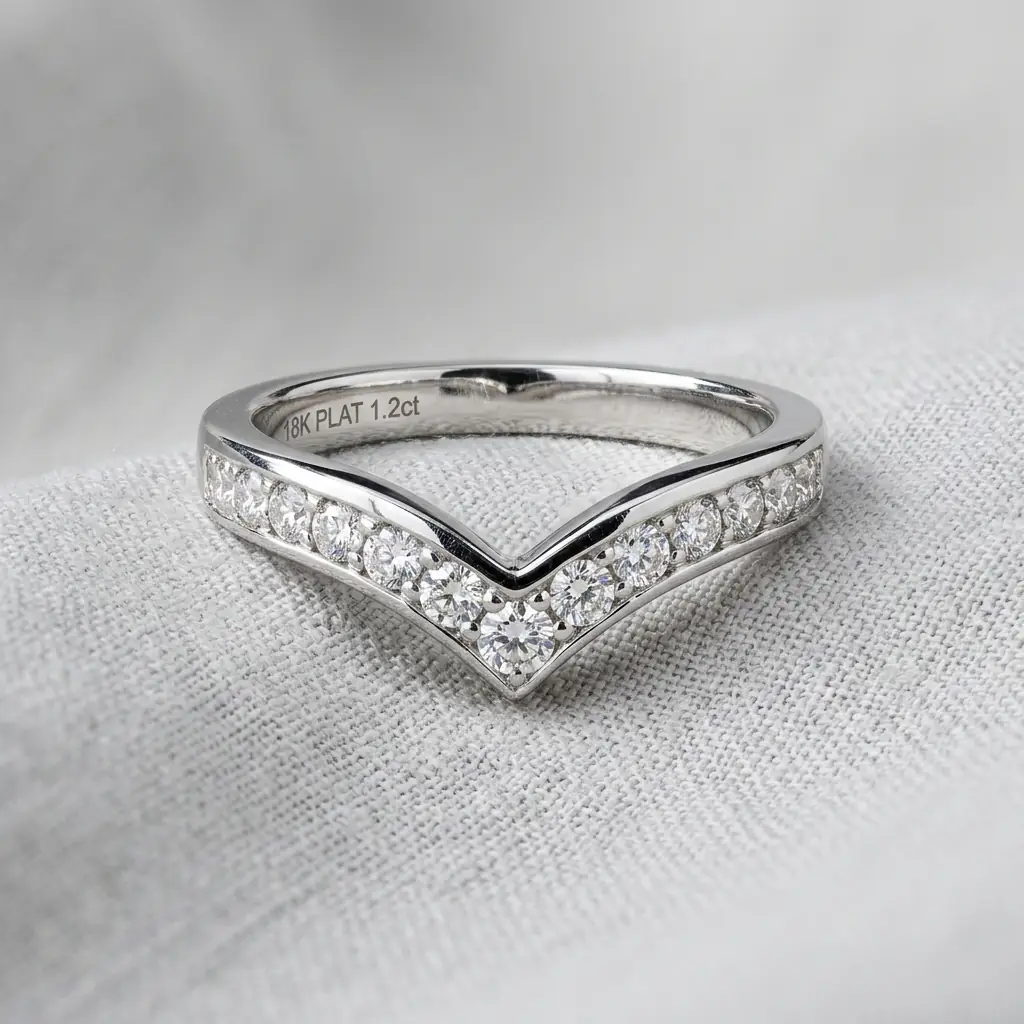
- A v shaped diamond wedding band (also called a chevron band) has a pointed notch that curves around the base of an engagement ring so the two sit flush.
- The most important measurement is the angle and depth of the V, which should match the shape of your engagement ring’s center stone and basket.
- Shallower V angles suit low-set solitaires; deeper, wider chevrons suit pear, marquise and large oval stones.
- Lab-grown diamonds are the practical default for pavé chevron bands because matched, consistent small stones matter more than rarity.
- Order the band only after the engagement ring is finalized, or have both made together, so the nesting fit is designed in CAD rather than guessed.
A v shaped diamond wedding band is a wedding ring with a pointed, chevron-style notch cut into the top edge so it curves around the base of an engagement ring instead of colliding with it. It solves a very specific problem: the moment a straight band meets a raised center stone and leaves an awkward gap.
That gap is why the style has moved from niche to mainstream. As engagement rings have grown more sculptural — bigger ovals, pear cuts, three-stone layouts, bezel-set centers — a plain straight band often no longer sits flush. Brides are treating the wedding band as a designed companion piece rather than an afterthought, and the chevron is the clearest expression of that shift.
Why the Trend Is Growing
- Engagement ring silhouettes have become more dimensional, with raised baskets and elongated fancy cuts that leave no room for a straight band.
- Buyers increasingly plan the wedding band at the same time as the engagement ring, so the pair is designed as a set rather than matched later.
- Lab-grown diamonds have made pavé-set, diamond-heavy bands far more accessible, so a fully set chevron is now a realistic everyday choice.
- Social platforms reward the visual payoff: a flush, gap-free stack photographs dramatically better than a mismatched pair.
The result is a category of ring that did not really exist at scale a decade ago. The chevron is no longer a compromise for an awkward setting; it is often the more interesting half of the set.
Why Buyers Care
The appeal is part engineering, part aesthetics, and the two are impossible to separate.
The Nesting Fit Problem
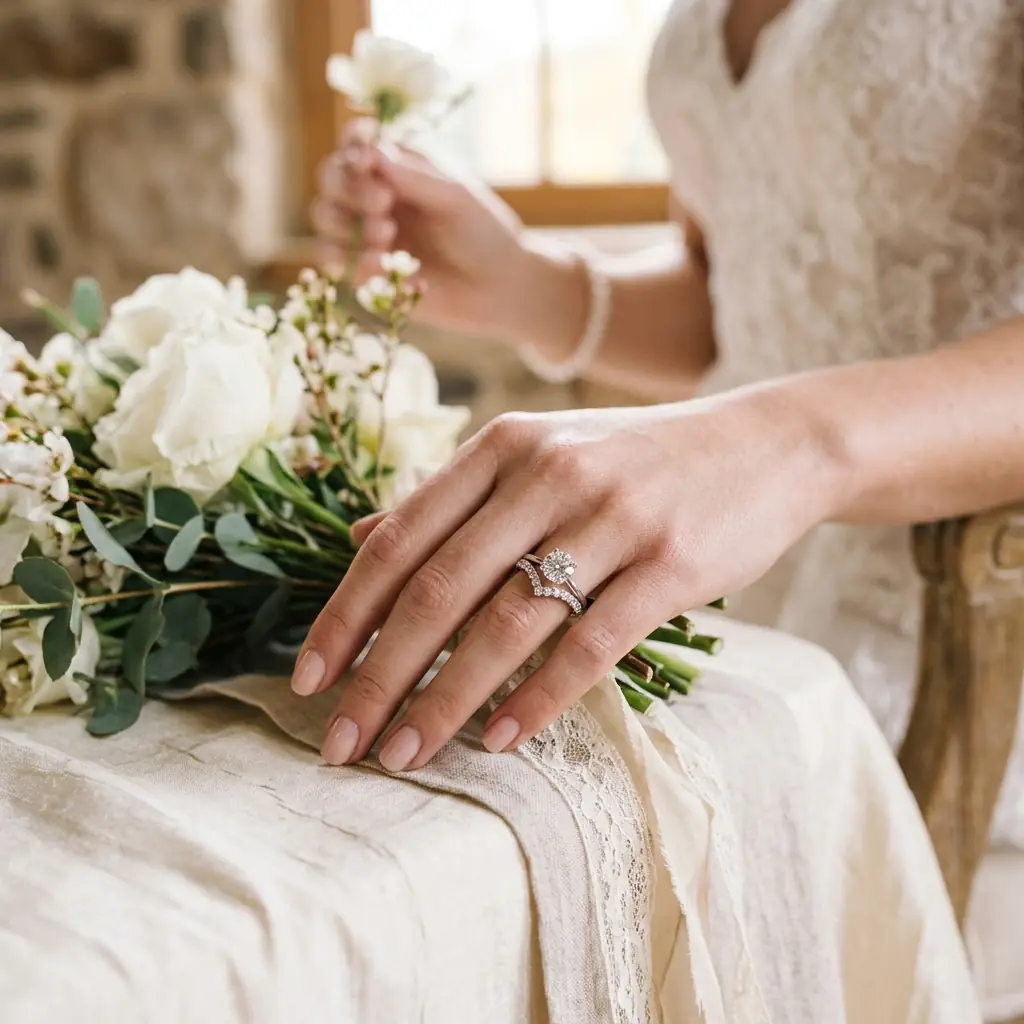
A straight band and a raised center stone create a visible wedge of empty space. Some people accept it, some wear the band on the opposite hand, and some spend months searching for a band that “almost” works. A chevron removes the problem entirely because the notch is cut to the exact profile of the ring it sits against.
This is why the V angle matters more than almost any other specification. A shallow V suits a low-set round or oval solitaire. A deeper, wider V is usually needed for pear and marquise cuts, whose pointed ends sit low and demand more clearance. Get the angle wrong and the band will either float above the finger or press against the basket.
Visual Balance Across the Hand
A chevron band also changes how the set reads. The point draws the eye upward toward the center stone, which elongates the finger and adds a sense of movement. On a three-stone ring, a V that echoes the shape of the side stones can look deliberate and architectural; on a simple solitaire, a slim pavé chevron keeps the look delicate.
The trade-off is that a pronounced V is harder to wear alone. If you plan to wear the band on its own some days, a softer, shallower curve is more versatile than a sharp point.
Metal, Stones and Everyday Durability
Chevron bands concentrate stress at the point of the V, so construction matters. Platinum is denser and wears slowly; 18K gold (75% pure gold, stamped 750) offers a warmer tone and a broader color range across yellow, white and rose.
For stones, lab-grown diamonds are the sensible default for a pavé chevron. What matters in a band is consistency — small stones of matching color and clarity set evenly along a curve. The lab-grown diamonds Alpha Jewelry offers are graded DEF color and VVS/VS clarity, which is exactly the kind of tight matching a pavé curve needs. Moissanite is a legitimate alternative and can look striking, though its optical character differs from diamond. Natural diamonds and customer-supplied stones are available on request for custom work.
One practical note on reports: only diamond center stones over 0.5 ct come with an IGI report, and moissanite center stones come with a GRA certificate. Smaller center stones and side stones do not carry those reports. In a pavé chevron, the stones are small by design, so the value sits in the setting quality and metalwork rather than in a certificate.
How to Choose: A Practical Comparison
| Feature | Straight band | Shallow V chevron | Deep V chevron |
|---|---|---|---|
| Best for | Low-set or flush rings | Round, oval, cushion solitaires | Pear, marquise, large fancy cuts |
| Gap against engagement ring | Often visible | Minimal | None |
| Worn alone | Most versatile | Versatile | Reads as a companion piece |
| Visual effect | Classic, understated | Subtle lift toward center stone | Strong elongation, architectural |
| Setting risk | Low | Low to moderate | Needs solid metal at the point |
A second decision is setting style along the band itself. Prong-set pavé shows more of each stone and sparkles more actively; bezel or channel setting protects the edges and suits hands that are hard on jewelry. For a chevron, many buyers choose prong-set stones along the arms and a slightly more protected treatment at the point, where knocks are most likely.
How the Custom Process Actually Works
Because the fit is geometric, a chevron band is one of the clearest cases for custom making rather than buying off the shelf. The usual route is to send a sketch, a reference image, or a CAD file, or simply the engagement ring itself for measurement. CAD and 3D design are confirmed before production, which is the stage where the V angle gets locked in.
That confirmation step is not a formality. It is the moment to check the notch depth against the actual basket, confirm the band width, and settle the finger size. Ring sizes cannot be changed after delivery, so size must be confirmed before CAD approval and production. Rings and pendants typically ship 7–14 days after CAD approval.
For couples ordering both pieces together, designing the engagement ring and the v shaped wedding band set in one CAD file is the most reliable way to guarantee a flush fit. This is standard practice for custom fine jewelry and removes the guesswork entirely. OEM and private label jewelry have MOQ 1 piece, which means a single bespoke band is a normal order, not an exception. Full payment is required before production; there is no deposit model.
A Note for Designers and Small Brands
If you are building a bridal collection rather than buying for yourself, the chevron is a useful shape to stock because it pairs with almost any center-stone silhouette. A single well-proportioned V master, offered in two or three angles, covers most of the range. Alpha Jewelry works on an OEM and private-label basis, so the finished pieces carry your brand; it does not offer ODM.
Further reading: Wikipedia overview of jewelry; GIA 4Cs of diamond quality; De Beers guide to the 4Cs.
FAQ
Q1: What is a v shaped diamond wedding band?
A: It is a wedding band with a pointed chevron notch cut into the top edge, designed to curve around the base of an engagement ring so the two rings sit flush without a gap.
Q2: How do I know what V angle I need?
A: The angle depends on your engagement ring’s center stone shape and how high the basket sits. Pear and marquise cuts usually need a deeper, wider V; round and oval solitaires often suit a shallower curve. Measuring the actual ring, or designing both in one CAD file, is the reliable way to get it right.
Q3: Can a v shaped diamond wedding band be worn on its own?
A: Yes, though a shallow V looks more like a standalone band. A deep, sharp chevron reads more clearly as a companion piece to an engagement ring.
Q4: Should I buy the wedding band before or after the engagement ring?
A: After, or at the same time. The band is cut to fit the engagement ring, so the engagement ring’s final dimensions need to be settled first.
Q5: Are lab-grown diamonds suitable for a chevron band?
A: They are the practical choice. A pavé band depends on small stones matching closely in color and clarity, and lab-grown diamonds can be selected consistently. The lab-grown diamonds Alpha Jewelry offers are graded DEF color and VVS/VS clarity.
Q6: Do the small diamonds in the band come with a certificate?
A: Usually not. Only diamond center stones over 0.5 ct come with an IGI report, and moissanite center stones come with a GRA certificate; the small pavé stones in a band do not carry individual reports.
Q7: Can I supply my own diamonds for the band?
A: Customer-supplied stones can be set on request for custom work. It is worth discussing the sizes and shapes early, because a chevron’s pavé layout is planned around the stones available.
Q8: How long does a custom chevron band take?
A: Rings and pendants typically ship 7–14 days after CAD approval. The CAD stage comes first and is where the V angle and fit are confirmed.
Q9: Can the band be resized later?
A: Ring sizes cannot be changed after delivery, so the size must be confirmed before CAD approval and production. This matters more on a chevron, where resizing would also disturb the notch geometry.
Q10: What metals are available?
A: Solid 9K, 10K, 14K, 18K and 22K gold in yellow, white or rose, plus Pt950 platinum. Alpha Jewelry does not offer 925 silver, sterling silver, vermeil or plated jewelry.
Final Thoughts
A chevron band is a small piece of engineering with an outsized effect on how a bridal set looks and feels. Get the angle right and the two rings behave as one; get it wrong and no amount of sparkle hides the gap. Measure the ring, confirm the CAD, and treat the fit as the design decision it is.
Materials and Production Facts
- We lead with lab-grown diamonds. Custom work can set other stones on request, including natural diamonds, moissanite, colored gemstones or customer-supplied stones. Offered lab-grown diamonds are DEF color and VVS/VS clarity.
- Available metals: solid 9K, 10K, 14K, 18K and 22K yellow, white or rose gold, and Pt950 platinum, set with lab-grown diamonds or moissanite. We do not offer 925 silver, sterling silver, vermeil, plated jewelry, or mold making as services.
- Alpha Jewelry is a precious-metal OEM jewelry factory in Panyu, Guangzhou, with 15+ years of fine-jewelry manufacturing experience; it is not a retail brand.
- OEM and private label jewelry have MOQ 1 piece; custom logo packaging has MOQ 100 pieces.
- Rings and pendants typically ship 7–14 days after CAD approval; other categories and bulk orders are quoted individually (bracelets typically about 20 days).
- Only diamond center stones over 0.5 ct come with an IGI report; moissanite center stones come with a GRA certificate. Smaller center stones and side stones do not carry those reports.
- Full payment is required before production; there is no deposit model. Payment may only be PayPal (including credit/debit cards paid through PayPal) or bank transfer.
- OEM and private label put your brand on the piece; no ODM service.
Start Your Custom Jewelry Project
- Request a quote: www.alphajewelry.com/contact/
Learn more: custom wedding rings · 3D jewelry design service · jewelry semi-mountings.


