
Blog
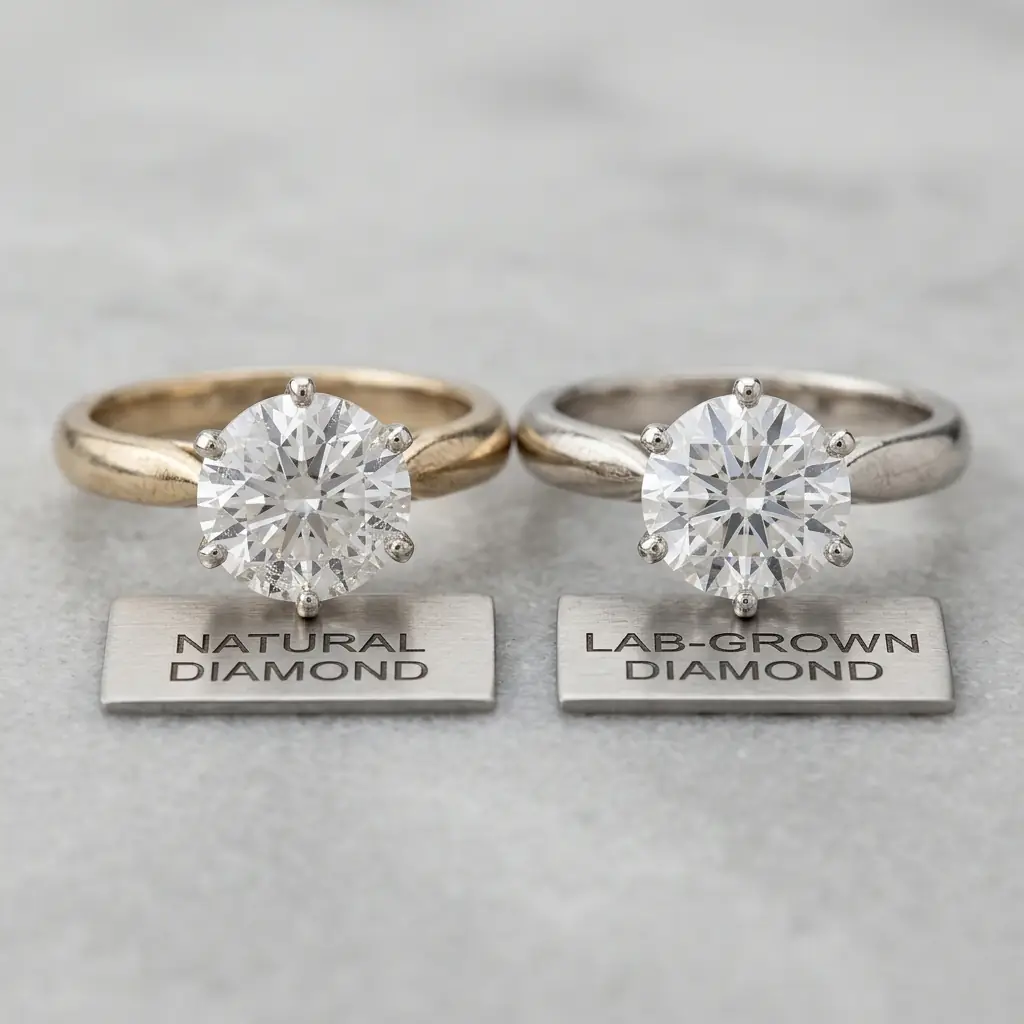
Both are real diamonds with the same carbon crystal and the same 4Cs grading. Natural diamonds formed underground over long periods; lab grown diamonds are produced in a growth reactor. In a lab grown vs natural diamonds comparison 2026, the practical differences come down to price, supply, traceability paperwork and resale expectations, not to how the stone looks in a setting.
Key takeaways
- Both types are graded on the same GIA 4Cs scales for color, clarity, cut and carat
- Lab grown stones are grown in reactors; natural stones form in the earth
- Lab grown supply is large and repeatable, which changes pricing and resale
- Ask for the growth method and any post-growth treatment on the report
- Match the stone type to your brand story and your customer’s resale expectations
What is the difference between lab grown and natural diamonds?
The difference is origin, not chemistry. A natural diamond crystallizes deep in the earth over a very long time. A lab grown diamond crystallizes in a growth chamber using either HPHT (high pressure, high temperature) or CVD (chemical vapor deposition). Both end up as carbon arranged in the same crystal structure, so they share hardness, brilliance and refractive behavior.
Because the material is the same, the grading language is the same. A VS1 lab grown stone and a VS1 natural stone are describing the same clarity threshold.
What differs in practice:
- Growth method and treatment. Lab grown stones may be grown by HPHT or CVD, and some are treated after growth to improve color. GIA has documented large as-grown CVD stones with no post-growth treatment, which shows the range on the market (GIA Lab Notes).
- Supply. Lab grown production can be scaled and repeated; natural supply depends on what is mined.
- Paper trail. Each comes with its own report language, and buyers should read the origin line carefully.
For a brand owner, the takeaway is simple: you are not choosing between a real diamond and a fake. You are choosing between two supply chains for the same material.
Lab grown diamond vs natural 2026: which costs less and why?
Lab grown diamonds generally cost less at the same carat, color and clarity, and the gap has widened as production scaled. The reason is supply mechanics, not quality. A growth facility can run continuously and produce consistent volumes, while natural stones come out of the ground in whatever sizes and qualities the deposit yields.
That changes how you plan a collection:
- Bigger stones become reachable. A customer who could afford a 0.75 ct natural stone may be able to spec 1.5 ct or more in lab grown at a similar budget.
- Matching becomes easier. For tennis bracelets, studs and halo bands, you need many stones of the same color and clarity. Lab grown supply makes matched parcels far more predictable.
- Price lists move. Lab grown pricing has been less stable over time than natural pricing, so quote lead times and lock costs with your factory rather than assuming last season’s numbers.
Do not promise customers a specific percentage saving. Quote from your own current supplier pricing on the exact spec you are selling. The comparison that matters is your cost per finished piece, not a headline ratio.
For brands building lab grown lines, Alpha Jewelry leads with lab-grown diamonds in DEF color and VVS–VS clarity, and can also set natural diamonds, moissanite, colored gemstones or customer-supplied stones. covers what the factory can source and set.
Do lab grown diamonds look different to the eye?
To the naked eye, no. A well-cut lab grown diamond and a well-cut natural diamond of the same color, clarity and cut look the same in a setting. Neither has a visible tell.
Differences show up under laboratory equipment, not at the counter. Gem labs identify origin using instruments that detect growth patterns and trace elements. That is why a report matters more than a loupe.
What actually changes the look of a finished ring:
- Cut quality. Proportions drive light return. A poorly proportioned stone of either origin looks dull.
- Color consistency across a parcel. In a pavé band or tennis bracelet, one off-color stone is visible. Specify a tight color range for melee.
- Setting style. A bezel hides girdle details; a thin four-prong solitaire shows everything.
- Metal choice. White metal reflects differently than yellow, which affects how the stone reads in photos.
If a customer asks whether they can tell, the honest answer is that nobody can by eye. What they can tell is whether the stone is well cut and whether the piece is well made. Spend the conversation there.
How should a brand choose between the two?
Start with the customer, not the stone. Two questions settle most of it: does this buyer care about resale value, and does this buyer care about origin story?
Choose natural when:
- The buyer sees the purchase as holding value and may resell.
- The brand story is built on heritage and traditional fine jewelry.
- The budget supports the carat size the customer wants.
Choose lab grown when:
- Size and sparkle matter more than resale.
- The buyer is uncomfortable with mining or wants a documented growth origin.
- You need matched parcels for bracelets, studs or pavé at volume.
- You want to offer a lower entry price without dropping to a smaller stone.
Many brands now run both lines and let the customer decide at the counter. That works if your displays and sales script keep the two clearly separated, so nobody feels misled later.
On the production side, both routes need the same discipline: approved CAD, stone specs locked in writing, and a pre-production sample signed off before bulk. Projects can begin with a sketch, a reference photo or a CAD file; production starts only after the 3D design is approved. explains how the modeling step is handled.
What paperwork should come with the stone?
Ask for the grading report before you approve the stone, and read three lines on it: origin, growth method (for lab grown), and any treatment comment.
A practical checklist for either origin:
- Origin stated clearly. The report should say natural or laboratory-grown, not leave it implied.
- 4Cs stated on the same scales. Color, clarity, cut and carat should be graded consistently so you can compare stones.
- Treatment disclosed. For lab grown, note whether color was improved after growth. For natural, note any clarity or color treatment.
- Matching reports for parcels. For melee in bracelets and pavé, ask how color and clarity are guaranteed across the lot.
- Consistency between report and stone. Confirm the report number matches the stone you receive.
For brands selling online, put the origin in the product title and the first line of the description. Buyers searching “lab grown diamond vs natural 2026” are already informed; vague listings lose their trust fast. An IGI report comes with diamond center stones over 0.5 ct and a GRA certificate with moissanite center stones; side stones and smaller center stones have no report. covers the documentation the factory provides.
What are the trade-offs over the life of the piece?
The stone is only part of the decision. Think about what happens after the sale.
Resale and value retention. Natural diamonds have an established secondary market. Lab grown stones trade at a steep discount once owned, so treat them as a purchase for wearing, not for storing value. Say this plainly to customers rather than letting them discover it later.
Service and repair. Both stone types take the same setting, sizing and polishing work. A lab grown stone can be replaced more easily and at lower cost if a prong fails, which matters for high-traffic designs.
Upgrades and trade-in programs. If your brand offers trade-in, decide early whether lab grown purchases qualify. Mixing the two in one program creates accounting headaches.
Inventory risk. Lab grown pricing has moved more than natural pricing, so holding deep stock carries more risk. Order closer to demand.
Brand positioning. A brand can carry both, but the story has to be coherent. A heritage campaign next to a value-focused lab grown banner confuses buyers.
None of these trade-offs is hidden. The brands that handle them well are the ones that put the facts in front of the customer and let them choose with clear eyes.
Lab grown vs natural diamonds: practical comparison for buyers and brands
| Attribute | Natural diamond | Lab grown diamond (HPHT/CVD) |
|---|---|---|
| Origin | Formed in the earth over a long period | Grown in a reactor chamber |
| Grading | GIA 4Cs: color, clarity, cut, carat | Same GIA 4Cs scales |
| Relative cost at same spec | Higher | Lower, and supply is scalable |
| Resale expectation | Established secondary market | Steep discount after purchase |
| Best fit | Heritage positioning, value-retention buyers | Size-focused buyers, matched parcels, volume lines |
Working With Alpha Jewelry
Alpha Jewelry is an OEM fine-jewelry factory in Panyu, Guangzhou, with 15+ years of manufacturing experience; it is a factory, not a retail brand. Alpha Jewelry accepts OEM and private label orders from a single piece; branded packaging has an MOQ of 100 pieces. After CAD approval, rings and pendants usually ship in 7–14 days, while bracelets take about 20 days and bulk orders are quoted case by case.
Examples from the catalog: Lab Grown Diamond Pear Cut Engagement Ring | Elegant Custom Design in 14K Gold, 14K Lab-Grown Round Cut Diamond Bridal Set | Elegant Engagement & Wedding Rings.
FAQ
Are lab grown diamonds real diamonds?
Yes. They are carbon in the same crystal structure as natural diamonds, with the same hardness and brilliance. GIA grades both on the same color and clarity scales, so a lab grown stone is a real diamond with a different origin, not a simulant.
Can a jeweler tell a lab grown diamond from a natural one by eye?
No. Under a loupe or by eye in a setting, they look the same. Gem laboratories identify origin with instruments that detect growth patterns and trace elements, which is why the grading report matters more than visual inspection at the counter.
Do lab grown diamonds hold their value?
They do not hold value the way natural stones do. Lab grown supply can be scaled, so resale prices are steeply discounted. Treat a lab grown purchase as something to wear and enjoy rather than an asset, and tell customers the same.
Is a lab grown diamond graded the same way as a natural one?
Yes. Both are graded on the GIA 4Cs: color on the D-to-Z scale, clarity, cut and carat weight. That shared language is what makes a side-by-side comparison possible, provided you compare stones at the same spec.
Which should I choose for an engagement ring?
Choose natural if resale value and heritage matter most to the buyer. Choose lab grown if a larger stone at the same budget matters more. Either way, put most of the budget into cut quality and setting workmanship, since that is what people actually see.
Sources
Related Reading
- Lab Diamond vs Natural Diamond Ring: The Complete 2026 Buyer’s Guide
- Lab-Grown Diamond Anniversary Ring: Private Label Supplier Guide
- Lab-Grown Diamond Cocktail Ring: Manufacturer OEM Guide
Start Your Custom Jewelry Project
Alpha Jewelry manufactures custom and private label fine jewelry for brands, with orders from one piece and in-house 3D design. Send us your sketch, reference photo or CAD file to request a quote.
- Request a quote: www.alphajewelry.com/contact/
- WhatsApp: wa.me/8618520595760
- Email: alpha_jewelry@163.com
Learn more: lab grown diamond jewelry · custom jewelry packaging · custom tennis bracelet.


